
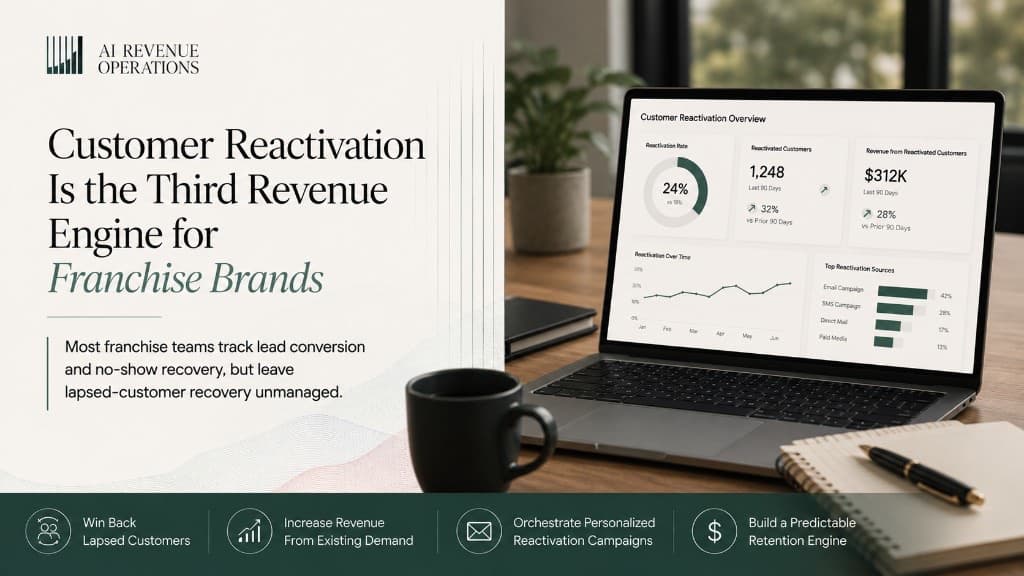
Most appointment-based franchise brands measure two revenue motions with discipline:
- New lead conversion
- No-show and cancellation recovery
Both matter. Both are already difficult to run consistently across locations.
But there is a third motion that usually gets ignored until growth stalls: reactivating customers who quietly stopped booking.
In many networks, this group is large, high-intent, and sitting in plain sight inside the booking system.
That is why customer reactivation should be treated as a core revenue operating layer, not a side campaign.
The Revenue You Already Paid For
Franchise operators spend real money to acquire first bookings.
When a customer drops out after one or two visits, the brand does not just lose future bookings. It also weakens the return on the original acquisition spend.
A missed reactivation opportunity often costs more than teams realize because the loss compounds across locations.
This is the same structural pattern we outlined in /blog/multi-location-revenue-gap: revenue breakdown happens in execution stages, not just at top-of-funnel demand.
And it connects directly to /blog/no-show-recovery-franchise-revenue-system: if no-show recovery is a system, post-lapse recovery must also be a system.
Why Reactivation Breaks in Multi-Location Franchises
Most brands are not failing from lack of effort. They are failing from unclear ownership and inconsistent workflows.
Common failure points:
- No shared definition of a "lapsed" customer by location and service line
- No standardized trigger window (for example, 30 days vs. 60 days without a visit)
- Generic blast messages that ignore prior visit history
- No routing for high-value customers who need a human call, not just text
- No weekly scoreboard tying reactivation work to booked revenue
The result is predictable: each location improvises, performance varies, and leadership cannot separate process failure from market conditions.
Current Market Signals Point the Same Direction
Recent franchise and retention coverage keeps returning to one core theme: operators are shifting focus from raw traffic volume to conversion quality and retained revenue.
Examples from recent signals:
- Franchising.com highlighted system-level pressure to move "from traffic to conversion" in franchise operations planning.
- LTVplus launched a franchise-focused reactivation service claiming strong early ROI around lapsed-customer winback in multi-location environments.
- Entrepreneur's retention analysis emphasized that many cancellations come from weak post-onboarding value capture, not just price sensitivity.
Sources:
- https://franchising.com/articles/20260331_franchise_brands_shift_focus_from_traffic_to_conversion.html
- https://www.globenewswire.com/news-release/2026/03/26/3263235/0/en/LTVplus-Launches-WinbackEngine-A-Performance-Based-Customer-Reactivation-Service-for-Multi-Location-Franchises.html
- https://www.entrepreneur.com/growing-a-business/want-to-retain-more-customers-make-this-marketing-shift/503260
You do not need to accept every vendor claim in those sources to see the operational takeaway:
Reactivation is no longer optional process debt. It is a core performance lane.
Define Reactivation Like an Operating Metric, Not a Marketing Tactic
If the goal is consistent results across locations, definitions come first.
Start with three concrete standards:
1. Lapse window by service type
Set one default lapse threshold (for example, 45 days since last completed appointment) and allow only explicit exceptions by vertical.
2. Segment logic
Separate reactivation queues by customer value and visit history.
A high-value returning member should not receive the same cadence as a one-time low-intent booking.
3. Recovery objective
Use one network-wide goal: recovered booked revenue, not only open rates or reply counts.
These standards make local execution measurable without forcing every location into identical messaging.
The Reactivation Workflow That Scales
A practical model for appointment-based franchises:
Step 1: Trigger the workflow automatically
The system should queue customers for reactivation based on lapse criteria and segment rules, without waiting for manual exports.
Step 2: Run a time-boxed sequence
Use a short sequence window (for example, 10 to 14 days) with clear intent progression:
- Reminder of prior relationship and service context
- Practical reason to rebook now (availability, continuity, seasonal timing)
- Low-friction booking path
- Final handoff to human outreach for priority segments
Step 3: Escalate priority accounts
For high-LTV cohorts, route to staff-assisted outreach with context from prior visits, provider preference, and package status.
Step 4: Suppress noise
Exclude customers with unresolved issues, active refund disputes, or recent no-show events already in another recovery queue.
Step 5: Close the loop to reporting
Every attempt, response, and rebook must map back to location and segment so operations leaders can coach execution directly.
KPI Stack for Weekly Reactivation Reviews
Track these at corporate and location levels:
- Reactivation pool size (eligible lapsed customers)
- Reactivation attempt rate
- Time-to-first-touch for reactivation queue
- Reactivation-to-booked conversion rate
- Recovered revenue from reactivation workflows
- 30-day repeat booking rate of reactivated customers
If your dashboard stops at message delivery, you are measuring activity, not revenue outcomes.
A 30-Day Rollout Plan
You can stand up a functional reactivation layer in one month.
Week 1: Instrument and baseline
- Define lapse thresholds by service line
- Build segment rules (value tiers, recency tiers)
- Pull baseline metrics by location
Week 2: Launch workflow v1
- Deploy automated trigger + sequence
- Define escalation rules for priority cohorts
- Train location teams on exception handling
Week 3: Pilot and tune
- Run across 5 to 10 locations
- Compare recovery conversion versus control locations
- Tighten copy and timing based on actual rebook behavior
Week 4: Network rollout
- Activate across all locations
- Add reactivation metrics to weekly operating reviews
- Coach bottom-quartile locations against top performers
This avoids the common mistake of treating reactivation as one campaign blast followed by silence.
Where This Fits in the Full Revenue System
For franchise brands, revenue execution should operate as one connected system:
- Lead conversion captures new demand
- No-show recovery reduces immediate leakage
- Customer reactivation restores medium-term recurring revenue
When those motions run separately, operators lose visibility and duplicate outreach.
When they run as one operating layer, teams can prioritize the right queue at the right time and improve bookings without linear staffing growth.
Final Take
Most franchise brands do not need more tools. They need clearer operating ownership of existing revenue opportunities.
Customer reactivation is one of the highest-ROI places to apply that discipline because the data already exists, the audience already knows your brand, and the workflow is repeatable across locations.
If your network has not defined reactivation as a weekly operating metric, that is likely the next revenue leak to close.
TractionDesk is built to help appointment-based franchise operators run lead conversion, recovery, and reactivation as one coordinated revenue system across every location.
If you want a practical benchmark, start by measuring your current lapsed-customer pool and rebook rate by location this week. The gap becomes obvious fast.