
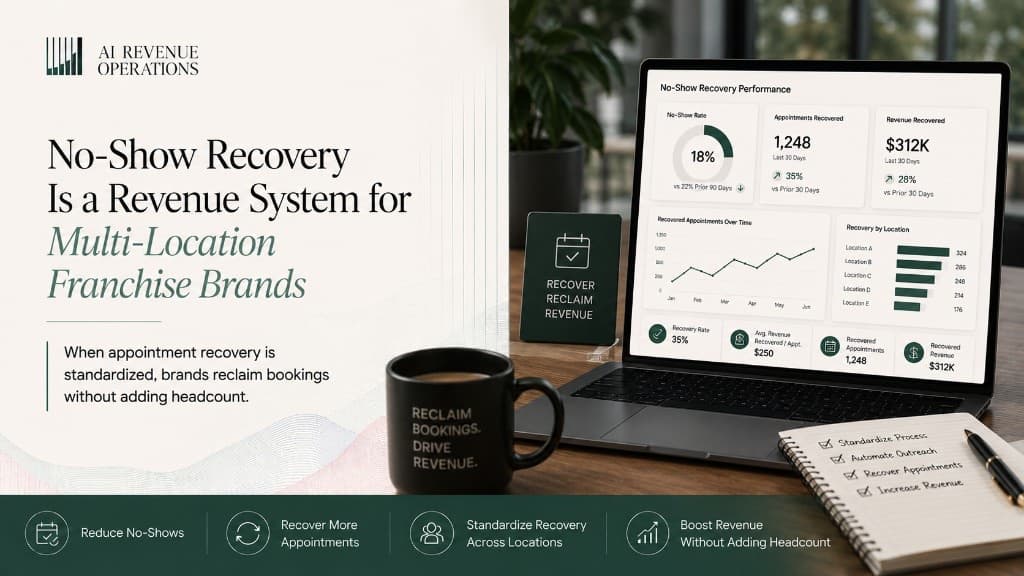
Most franchise operators treat no-shows like a local staffing issue.
A customer misses an appointment, the front desk calls when they can, and everyone moves on. That approach feels normal, but it creates a predictable revenue leak across the network.
If you operate 20, 80, or 300 locations, no-show recovery is not a front-desk task. It is an operating system problem.
When recovery is inconsistent, your brand pays three times:
- You lose the missed appointment revenue itself.
- You waste demand spend that generated the booking in the first place.
- You create reporting blind spots that make underperformance look random.
This is the same execution gap behind the multi-location revenue loss pattern we covered in The Multi-Location Revenue Gap. The difference is that no-show recovery is one of the fastest areas to fix because the workflow is repeatable.
The Hidden Pattern: No-Shows Compound Faster Than Teams Expect
At one location, a few missed appointments per week can look manageable.
At network scale, those misses stack quickly. Even modest no-show rates create a large weekly backlog of unrecovered demand, especially in appointment-driven categories like fitness, wellness, medspa, tutoring, and home services.
The operational impact is broader than one canceled time slot:
- Daily schedules become less predictable.
- Staff time shifts from high-value work to ad hoc follow-up.
- Location managers rely on manual workarounds to fill gaps.
- Corporate sees lagging indicators instead of near-real-time recovery performance.
Industry coverage across service businesses continues to highlight the same failure mode: missed appointments are often treated as customer service friction, even though they are measurable operational loss. Recent field-service reporting frames missed appointments as a direct drag on billable capacity and scheduling efficiency, not just a communications annoyance (Xcelerate article).
The same logic applies to franchise appointment businesses.
Why Recovery Breaks in Multi-Location Environments
Most brands do not fail because they lack effort. They fail because their recovery model depends on local heroics.
1. No single recovery standard
Each location handles no-shows differently. One team calls immediately, another sends a text later, another does nothing if they are short-staffed.
That inconsistency turns recovery performance into a staffing lottery.
2. Slow first response after a missed appointment
Response speed matters before the appointment and after it. The longer a brand waits to re-engage, the lower the chance of rebooking while intent is still high.
3. No escalation logic by customer value and intent
Many teams run one generic follow-up message for every missed appointment. High-intent or high-LTV customers deserve a different cadence than low-intent contacts.
4. Fragmented ownership between marketing and operations
Marketing reports demand volume. Ops reports schedule fill. Neither team owns the full recovery funnel end to end.
5. Weak network visibility
Without location-level recovery metrics in one view, corporate cannot identify which locations need process correction versus coaching.
This is the same governance tension that appears across multi-location operating models in other domains: centralized standards are needed, but execution still happens locally (Apollo multi-location governance analysis).
The Operating Shift: From Manual Follow-Up to Recovery System
Treat no-show recovery as a defined pipeline with explicit service levels.
A practical structure looks like this:
Step 1: Trigger recovery the moment a no-show is confirmed
Recovery should start automatically when an appointment is marked missed, not when a staff member remembers to follow up.
Step 2: Enforce a 30-minute first-response SLA
Set a clear standard: first outreach inside 30 minutes of the no-show event.
The goal is simple: re-engage while context and intent are still fresh.
Step 3: Use multi-step cadence, not one message
A working baseline for many brands:
- Message 1: immediate acknowledgment + easy reschedule link.
- Message 2: short reminder later the same day.
- Message 3: next-day check-in with a clear booking window.
- Message 4: final nudge before the lead moves into reactivation status.
Step 4: Prioritize by segment
Route high-value segments to stronger follow-up paths (for example, staff-assisted call queue or tighter message spacing). Keep lighter automation for low-intent segments.
Step 5: Track recovery as a core KPI set
At minimum, report these by location and network-wide:
- No-show rate
- Recovery attempt rate
- Time to first recovery touch
- Recovery-to-rebook rate
- Revenue recovered from no-show flow
When these metrics are visible daily, underperformance stops hiding inside anecdotal updates.
What Corporate Should Standardize vs. What Locations Should Control
A lot of franchises overcorrect one direction or the other.
They either centralize everything and lose local flexibility, or they push everything local and lose brand consistency.
A better split:
Corporate owns
- Recovery workflow design
- Service-level targets (for example, first response SLA)
- Message templates and guardrails
- KPI definitions and reporting model
- Exception routing rules
Location teams own
- In-shift execution quality
- Escalation handling for edge cases
- Local context captured in notes
- Schedule availability decisions
This model keeps execution local but makes performance governable at the network level.
How to Roll This Out in 30 Days
You do not need a six-month transformation project to improve no-show recovery.
A focused rollout plan:
Week 1: Baseline and instrumentation
- Pull current no-show and rebook rates by location.
- Define one KPI dictionary used by every team.
- Establish first-response SLA and reporting cadence.
Week 2: Workflow build
- Configure no-show event triggers.
- Implement message cadence and segment rules.
- Set escalation rules for high-value accounts.
Week 3: Pilot in 5-10 locations
- Compare pilot recovery KPIs versus control locations.
- Identify friction points in reschedule paths.
- Tighten templates for clarity and tone.
Week 4: Network rollout + weekly operating review
- Deploy standard workflow to remaining locations.
- Add recovery metrics to the standing ops review.
- Coach bottom quartile locations against top performers.
If you can execute this sequence with discipline, recovery performance usually improves before broader demand-generation changes show up.
The Strategic Payoff
When no-show recovery becomes a system, brands gain more than recovered appointments:
- More predictable location-level revenue.
- Better return on existing demand spend.
- Cleaner operational signals for leadership decisions.
- Less dependence on ad hoc staff heroics.
In a franchise network, consistency is not about control for its own sake. It is about making outcomes repeatable.
No-show recovery is one of the clearest places to prove that principle.
If your brand still handles no-shows with manual one-off follow-up, the issue is not team effort. The issue is system design.
TractionDesk is built to help appointment-based franchise brands standardize execution at the location level and turn missed opportunities into measurable recovered revenue.
Read more operating-system guidance for franchise growth at tractiondesk.com/blog.