
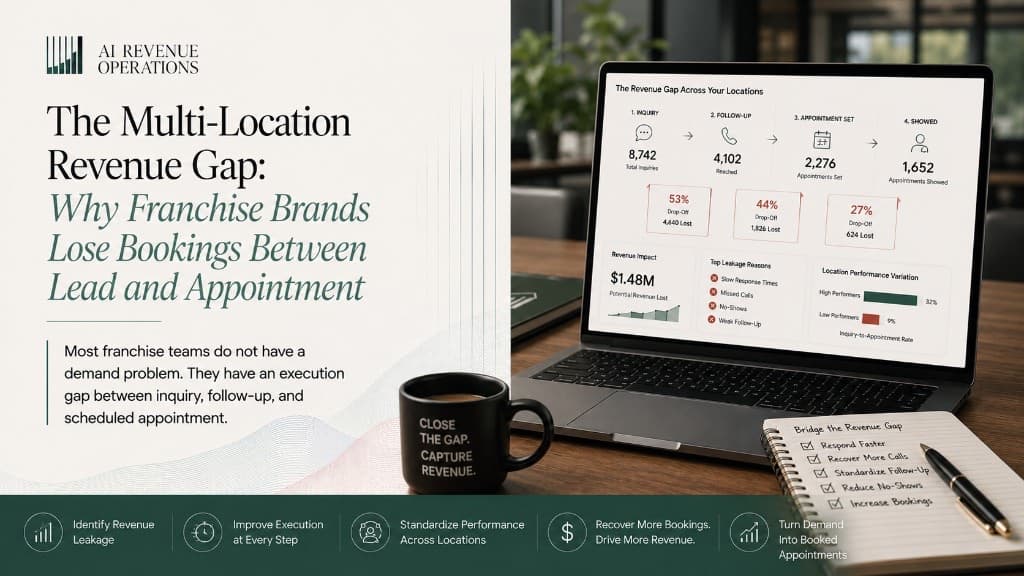
Most appointment-based franchise brands think growth stalls because lead volume is too low.
In practice, the bigger problem sits one step later: the handoff between marketing demand and location-level execution.
Leads come in. Follow-up is delayed. Calls go unanswered. No-show recovery happens manually, if it happens at all. Reporting arrives too late to correct behavior this week.
When this pattern repeats across 20, 50, or 200 locations, the brand does not just miss bookings. It loses operating trust. Corporate believes marketing is underperforming. Locations believe corporate sends poor leads. Both are partly wrong.
The missing layer is revenue operations built for multi-location execution.
The Revenue Gap Is Operational, Not Theoretical
A recent International Franchise Association piece on multi-location technology challenges describes the same pressure many operators are feeling now: systems are fragmented, and consistency gets harder as networks expand.
That reality shows up in appointment businesses as four recurring leaks:
- Response-time decay: the first follow-up lands too late to capture intent.
- Handoff ambiguity: no one owns the lead after intake.
- No-show leakage: cancellations and missed appointments are not recovered with disciplined workflows.
- Visibility lag: location metrics are reported after revenue loss has already happened.
None of these are marketing-channel issues by themselves. They are execution issues.
Where Multi-Location Brands Usually Break
Most franchise orgs run this stack today:
- Paid and organic demand generation at corporate level
- A booking or scheduling tool at the location level
- Some CRM fields, often incomplete or inconsistent
- A mix of SMS/email call tools by market or by owner preference
- Weekly or monthly reporting decks
That stack can work in a single-location business. It breaks at scale because each tool optimizes a local step, but no system governs the full revenue journey from inquiry to booked appointment to retention.
The consequence is predictable: teams over-index on top-of-funnel spend while under-managing the handoff and recovery stages where margin is won.
The Unit-Level Math Leaders Miss
A franchise network does not need catastrophic failure to miss growth targets. It only needs small, repeated leaks.
Example:
- 75 locations
- 220 inbound leads per location per month
- 16,500 leads network-wide
- If just 8% of viable leads fail due to late response or poor handoff, that is 1,320 missed booking opportunities monthly
Now add no-show and cancellation leakage. If each location could recover even a handful of those appointments with structured outreach, annual revenue impact is material.
This is why leaders should treat response speed, handoff compliance, and recovery workflows as board-level metrics, not support metrics.
The Operating Model That Closes The Gap
Franchise brands that improve bookings and retention consistently tend to implement the same model:
1. Define non-negotiable SLAs at location level
Set hard standards for first response and follow-up cadence by lead type. Do not leave this to individual manager preference.
2. Standardize lead state transitions
Every location should use the same lifecycle definitions. If status fields differ by location, performance comparisons become noise.
3. Automate first-touch and no-show recovery
Human teams should focus on high-context conversations. Time-sensitive first-touch and recovery loops should be automated with escalation rules.
4. Monitor execution daily, not monthly
Operators need visibility into conversion and response behavior while there is still time to intervene.
5. Deploy one playbook, localize constraints
Corporate should set core operating playbooks once, then allow controlled local variation for staffing and market-specific constraints.
That is the core promise of a franchise operating layer: consistency without rigidity.
The KPI Stack To Run Weekly
If you manage a multi-location appointment brand, these KPIs should be visible at corporate and unit level every week:
- Median first-response time
- Lead-to-appointment conversion rate
- No-show rate
- No-show/cancellation recovery rate
- Reactivation conversion rate for lapsed customers
- Bookings per location, normalized by lead volume
Pair these with exception alerts. A dashboard without action triggers is only documentation.
A 90-Day Rollout Plan For Franchise Operators
You do not need a full platform migration to start.
Days 1-30: Baseline and normalize
- Audit lead-source to booking flow by location
- Standardize lifecycle statuses and field requirements
- Publish response-time and follow-up SLAs
Days 31-60: Automate high-leak steps
- Launch automated first-touch sequences for missed calls/forms
- Launch no-show and cancellation recovery workflows
- Create escalation paths for stalled leads
Days 61-90: Enforce and optimize
- Add location-level scorecards tied to execution metrics
- Coach outliers with specific workflow data
- Reallocate spend only after execution quality is stable
This sequence prevents a common mistake: adding more top-of-funnel volume into a weak conversion system.
What This Means For 2026 Planning
The brands that win this year will not be the ones with the most tools. They will be the ones that make location execution measurable and repeatable.
In a post-spreadsheet environment, revenue growth depends on operating clarity:
- One operating model for inquiry, booking, recovery, and retention
- One source of truth for location performance
- One set of playbooks deployed across the network
If your current stack still requires manual patchwork between teams, you are likely funding demand faster than you can convert it.
For additional context on TractionDesk's approach to the operating layer, start with /features/how-it-works and sector examples like /verticals/fitness. If you are new to this blog format, the intro post is at /blog/test-post.
Final Take
Franchise growth does not fail because operators do not care. It fails because systems were not designed to enforce consistent execution at location scale.
Close the gap between lead and appointment, and your existing demand performs better.
Close the gap between appointment and retention, and unit economics improve without linear headcount growth.
If you want to evaluate where your network is leaking bookings today, map your current response, handoff, and recovery flow end-to-end. Then pressure-test every step against location-level accountability.
When the operating layer is strong, growth gets less noisy and more predictable.