
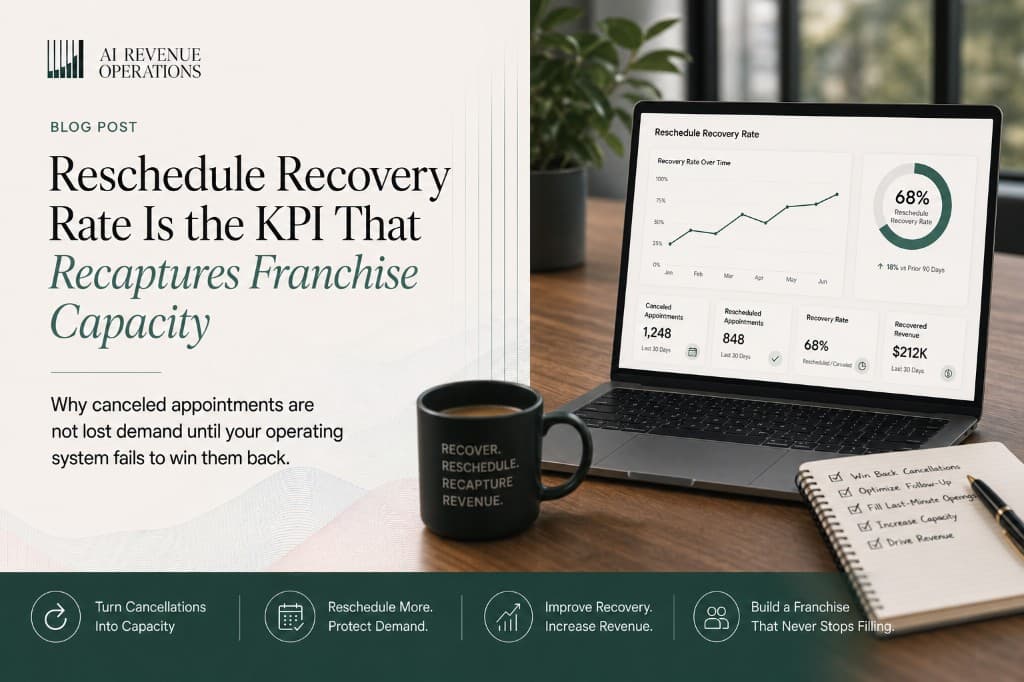
Most franchise teams already track cancellations.
Fewer teams track what happens next.
That gap creates a false story in weekly reviews. Leaders see the canceled appointment count, call it a demand problem, and move on. But the real performance question is not how many people canceled. The real question is how many of those customers were recovered into a new booked slot within an acceptable window.
That is what reschedule recovery rate measures.
If your brand does not track it at the location level, you are not measuring capacity recovery. You are only measuring capacity loss.
Reschedule Recovery Rate Defined
Reschedule recovery rate is simple:
Recovered canceled appointments / total canceled appointments
A recovery counts when a canceled customer is rebooked into a future slot within your brand's defined recovery window (for example: 7 days for high-frequency services, 14 days for lower-frequency services).
If 100 appointments cancel this week and 42 are rebooked in-window, your reschedule recovery rate is 42%.
This KPI matters because it translates cancellation events into operational outcomes:
- A low rate means your workflow lets revenue walk away.
- A high rate means your workflow converts disruption into retained demand.
Cancellations are inevitable. Unrecovered cancellations are optional.
Why This KPI Belongs in Every Franchise Review
Franchise organizations run on repeatability. The problem is that most reschedule behavior is still location-specific, front-desk-specific, and shift-specific.
One studio actively rebooks every canceled client within minutes. Another sends one generic message and stops. A third never attempts same-day recovery at all.
On paper, all three locations may report similar cancellation volumes. In reality, they are running different revenue systems.
Reschedule recovery rate exposes that hidden execution spread.
It also pairs directly with other operating KPIs your team is already using:
- Pair it with First-Call Booking Rate to understand whether lead conversion gains are being protected after booking.
- Pair it with No-Show Recovery to measure post-booking recovery maturity end to end.
- Pair it with Call Overflow Rate to see when location staffing pressure undermines recovery attempts.
When these metrics are reviewed together, you stop managing disconnected events and start managing appointment lifecycle throughput.
The Hidden Cost of Low Recovery
Most operators underestimate the second-order effects of low reschedule recovery.
The first-order loss is obvious: the canceled slot does not produce revenue.
The second-order losses are bigger:
- Marketing efficiency drops because acquired demand decays before service.
- Team utilization gets noisier because daily schedule reliability degrades.
- Customer retention weakens because a canceled visit without quick rebooking often becomes churn.
- Forecast confidence falls because near-term booked volume is less stable than expected.
If you are spending to create demand and then failing to recover canceled demand, you are paying twice for the same customer journey.
What Strong Recovery Systems Actually Do
High-performing locations do not treat cancellations as one-off inbox tasks. They run a timed recovery system.
At a minimum, that system includes:
-
Immediate acknowledgment A cancellation event triggers a response within minutes, not hours. The goal is to keep intent warm.
-
Multi-window follow-up If rebooking does not happen in the first contact, the customer enters a short, structured sequence with clear stop conditions.
-
Channel adaptation Some customers respond to SMS, others to voice, others to email. Recovery logic should route by observed behavior, not by staff preference.
-
Slot-aware messaging Recovery prompts should reference realistic availability windows, not generic "let us know" copy.
-
Escalation paths High-value customers or repeated cancellations should route to human follow-up quickly.
None of this requires adding operational chaos. It requires a consistent playbook and visibility across locations.
Location-Level Benchmarks That Matter
A single global target is not enough.
Reschedule recovery should be benchmarked by service line, by location, and by cancellation reason segment. A medspa service with long lead times has different recovery dynamics than a high-frequency fitness class.
A practical benchmark framework:
- Brand baseline: median recovery rate across all locations
- Bottom quartile threshold: triggers coaching and workflow audit
- Top quartile behaviors: codify and deploy as system playbooks
- Time-to-recovery median: how long it takes to rebook after cancellation
Time-to-recovery is important because two locations can have the same recovery rate but very different speed. Faster recovery protects schedule integrity and reduces churn risk.
Common Failure Modes
Most low-performing systems fail in one of four ways:
-
No defined recovery window Teams cannot improve what they do not define. Without an in-window rule, recovery reporting is inconsistent.
-
Manual-only execution If reschedule flow depends on one busy staff member, performance collapses during peak load.
-
No ownership When no role owns recovery outcomes, everyone assumes someone else handled it.
-
Reporting lag If corporate sees this KPI two weeks late, intervention arrives after the revenue window closes.
The fix is not motivational language. The fix is instrumentation, ownership, and consistent workflows.
How Corporate Teams Should Roll This Out
For multi-location brands, rollout should be operational, not theoretical.
Start with a 30-day deployment sequence:
Week 1: Definition and measurement
- Lock the recovery window definition by service category.
- Standardize what counts as a recovered booking.
- Validate data capture from cancellation event to rebook event.
Week 2: Workflow standardization
- Deploy baseline follow-up sequences with timing rules.
- Define escalation conditions and location manager responsibilities.
Week 3: Coaching and exceptions
- Review bottom-quartile locations with examples, not averages.
- Audit missed recoveries by reason code.
Week 4: Performance loop
- Publish location leaderboard and trend lines.
- Promote top-quartile workflows to brand standard.
This turns recovery from ad hoc behavior into a managed operating process.
What to Watch in Executive Reporting
At the executive layer, keep the dashboard focused on decisions:
- Reschedule Recovery Rate (brand + location distribution)
- Median Time to Recovery
- Recovered Revenue (estimated)
- Recovery Rate vs No-Show Rate trend
- Recovery Rate vs Retention trend
If the KPI is rising but recovered revenue is flat, your average ticket mix may be shifting. If the KPI is flat while cancellation volume rises, you may need capacity and staffing adjustments before workflow changes.
The point is not just to display data. The point is to detect where execution breaks and intervene fast.
The Strategic Point
Franchise growth does not fail at strategy slides. It fails in repeated operational moments.
A canceled appointment is one of those moments.
Brands that treat cancellation as final outcome lose revenue and capacity. Brands that treat cancellation as recoverable workflow protect both.
Reschedule recovery rate gives corporate teams a direct view into which locations are preserving demand and which are leaking it.
That is why this KPI belongs in the core operating scorecard.
If you want predictable bookings, stronger retention, and cleaner unit economics, you need to measure how reliably your system recaptures canceled demand.
TractionDesk helps franchise operators run that recovery layer consistently across every location, with automation, visibility, and location-level accountability built in.