
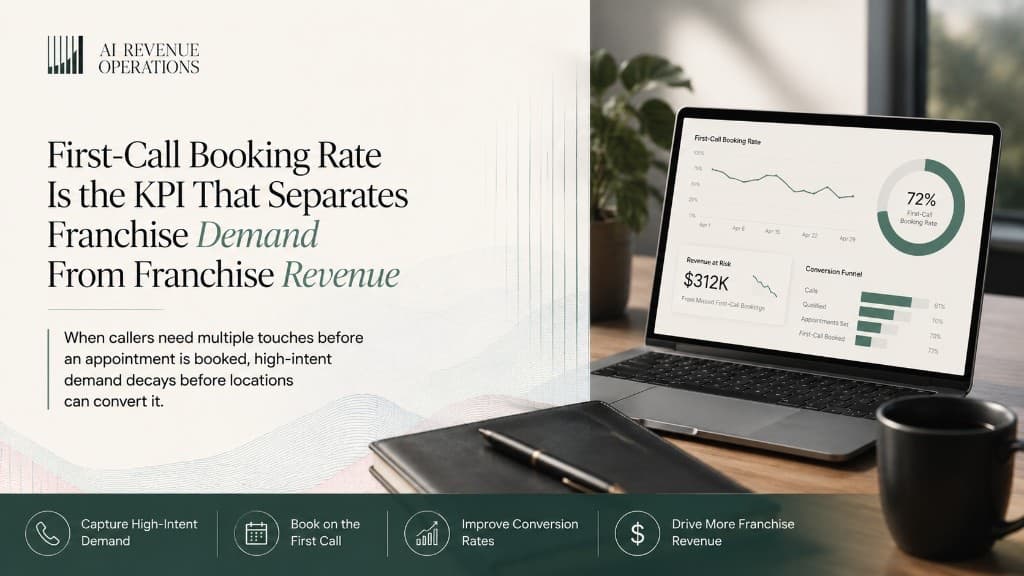
Most franchise leadership teams monitor lead volume. Most monitor total bookings.
Fewer monitor the conversion moment that sits between those two numbers:
How often does an inbound call turn into a booked appointment on that same call?
That metric is First-Call Booking Rate.
If this rate is low, your system is forcing high-intent prospects into callbacks, follow-ups, and delays that should not exist. In appointment-based franchises, that delay is not a neutral handoff. It is conversion risk.
This is why First-Call Booking Rate should be managed as a core revenue-operations KPI, not a front-desk preference.
What First-Call Booking Rate actually measures
First-Call Booking Rate answers a simple question:
Of the inbound calls where booking intent exists, how many end with a confirmed appointment before the call ends?
A practical formula:
First-Call Booking Rate = Calls Booked on First Conversation / Booking-Intent Inbound Calls
Important scope notes:
- Use booking-intent calls, not total calls. Billing, directions, and general inquiries dilute signal quality.
- Measure by location and daypart. System averages hide operational variance.
- Track trend and spread. Direction and consistency matter more than a one-week spike.
This KPI is not a replacement for lead-to-booking conversion. It is the operational lens that explains why lead-to-booking moves up or down when demand volume is stable.
Why this KPI matters in franchise systems
In multi-location systems, a low First-Call Booking Rate compounds quickly.
One location missing first-call conversion by 10 points is a local problem. Fifty locations missing by 10 points is a system-level revenue leak.
When this KPI falls, three things usually follow:
-
Callback queues expand Calls that should have converted now require recovery workflows, increasing operational load.
-
High-intent demand cools off Customers calling to book now are often evaluating alternatives in parallel. Delay is competitive exposure.
-
Acquisition efficiency erodes Marketing generates demand, but execution cannot capture it at the moment of highest intent.
This is the same execution gap pattern discussed in The Multi-Location Revenue Gap: demand is generated centrally, but revenue is won or lost in local operating behavior.
How First-Call Booking Rate connects to adjacent KPIs
First-Call Booking Rate should be read with the rest of your access and conversion stack:
- Speed-to-Lead Is the First Revenue Engine for Franchise Brands
- Call Overflow Rate Is the KPI That Predicts Franchise Front-Desk Overload
- Missed-Call Callback Time Is the KPI That Protects Franchise Booking Throughput
- Call Abandonment Rate Is the KPI That Exposes Franchise Access Friction
Read together, these KPIs answer the full flow:
- Are we reachable when calls come in?
- Are we handling volume without queue failure?
- Are we converting in the same conversation?
- If not, how quickly are we recovering?
If you only track one metric, you get symptoms. If you track the stack, you get root cause.
What “good” looks like
Benchmarks vary by vertical, but most appointment-based franchise systems can use practical guardrails:
- 65%+: healthy first-conversation conversion in many categories
- 50% to 65%: caution zone; process inconsistency usually exists
- Below 50%: conversion friction likely systemic
Do not manage this as a single universal threshold. Manage it as:
- trend by location,
- spread across the network,
- and sensitivity to daypart spikes.
A franchise with a 62% average can still have ten locations below 40%, which means corporate still has an execution problem.
Why first-call conversion breaks
Across appointment-based operators, the failure patterns are consistent:
-
Script drift at location level Teams are not using a standardized booking path, so call outcomes depend on who answered.
-
Capacity ambiguity Staff cannot see viable appointment inventory quickly enough to close in-call.
-
Offer and qualification friction The call path asks too many questions before confirming a next step.
-
Escalation dependence Agents defer decisions that should be handled in-call, creating callback debt.
-
Tool fragmentation Phone, scheduling, and customer context live in separate systems, slowing response.
None of these are solved by more lead volume. They are solved by tightening conversion operations.
Operating cadence for corporate teams
If you want First-Call Booking Rate to improve system-wide, treat it as a managed operating cadence, not a dashboard metric.
A practical weekly review should include:
-
First-Call Booking Rate by location Identify top and bottom quartiles.
-
Rate by daypart Spot where peak windows degrade conversion behavior.
-
Agent-level or team-level variance Find script and workflow inconsistency.
-
Callback dependency ratio Measure how often calls become follow-up tasks.
-
Downstream show-rate of first-call bookings Validate that faster booking still produces qualified attendance.
This structure keeps the KPI tied to revenue quality, not just speed.
A 14-day intervention when a location drops
When a location falls below threshold, run a focused intervention:
-
Days 1-2: Diagnose call outcomes Sample recordings and call notes for booking-intent calls that did not close.
-
Days 3-4: Tighten booking script Standardize opening, qualification, and close structure.
-
Days 5-6: Reduce decision latency Ensure booking inventory and basic policy answers are available during call.
-
Days 7-9: Rebalance staffing by demand window Move experienced coverage into peak call periods.
-
Days 10-11: Enforce same-call close behavior Coaching focus: confirm next step before call termination.
-
Days 12-14: Measure and codify Track lift, document playbook changes, replicate to similar locations.
This is how franchises convert one-location recovery into repeatable system behavior.
The strategic implication
Franchise brands rarely fail because they cannot generate enough demand. They fail because they do not capture demand at the point of intent.
First-Call Booking Rate is one of the cleanest ways to measure that capture quality.
When this rate rises:
- callback burden drops,
- booking throughput improves,
- and acquisition spend converts more efficiently.
When it falls:
- operations become reactive,
- conversion slows,
- and corporate teams misdiagnose the problem as a top-of-funnel issue.
This is why First-Call Booking Rate belongs in the core revenue-operations scorecard for every appointment-based franchise network.
Where TractionDesk fits
TractionDesk is built to help franchise operators run this layer with consistency across locations.
That means connecting call outcomes, booking conversion behavior, and location-level performance into one operating view so corporate teams can:
- detect first-call conversion drift early,
- trigger location-specific playbooks quickly,
- and improve booked revenue without linear headcount growth.
If your brand is generating demand but still depending on callbacks to close basic booking intent, the system is not converting at point of contact.
That is a revenue-operations problem. And it is fixable.