
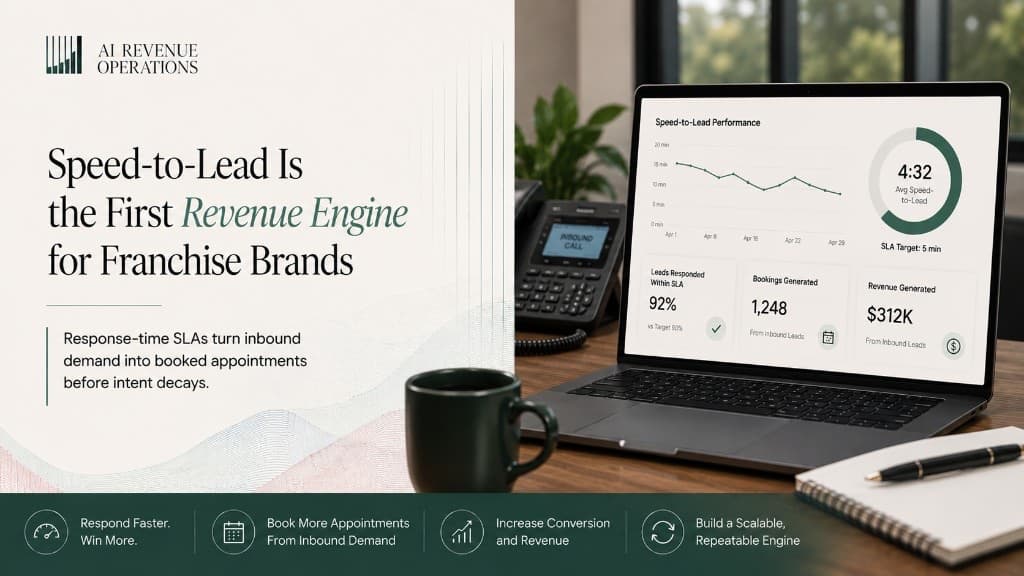
Most franchise operators think they have a lead quality problem.
In reality, many have a response-time problem.
Leads submit forms, call locations, or message after seeing paid media. Then the handoff slows down. A call goes to voicemail. A form waits in a queue. A front desk team gets busy with in-person traffic. By the time follow-up happens, intent has cooled.
That delay is not a small workflow miss. At multi-location scale, it is a direct revenue leak.
This is the front edge of the same operating gap covered in The Multi-Location Revenue Gap: demand generation and location execution are disconnected. If the first response is inconsistent, every downstream KPI suffers, including no-show recovery and reactivation performance.
Speed-to-lead should be treated as the first revenue engine in franchise operations.
Why Speed-to-Lead Breaks in Multi-Location Systems
Single-location businesses can survive on manager heroics.
Franchise networks cannot.
When 20, 80, or 300 locations are all handling inquiries differently, response-time variance becomes structural:
- Different staffing models by location
- Different call handling behaviors by shift
- Different definitions of what counts as a "contacted" lead
- Different urgency between corporate campaigns and local execution
The result is predictable. Two locations with similar lead volume can produce very different booked appointment outcomes because one responds quickly and one does not.
That is an operating-system failure, not a marketing-channel failure.
The Cost Pattern Most Teams Miss
Leaders usually see this issue too late because reporting is grouped by weekly or monthly summaries.
By the time metrics look weak, the recovery window for many leads has already closed.
Response-time decay creates a compounding pattern:
- A slower first response lowers immediate booking conversion.
- More leads move into longer nurture paths than necessary.
- Front desk teams spend more time on stale follow-up.
- No-show and reactivation workflows receive lower-intent traffic.
- Marketing teams react by increasing spend instead of fixing execution.
This is why speed-to-lead is not a service-level vanity metric. It is a throughput control for the whole revenue pipeline.
What "Fast" Actually Means Operationally
Most teams say "respond faster" without defining standards.
That instruction does not scale.
You need explicit SLA tiers tied to inquiry source and appointment intent.
A practical starting framework:
- Inbound calls during business hours: immediate answer target, with missed-call callback inside 5 minutes.
- Web form submissions: first touch inside 10 minutes.
- After-hours inquiries: automated acknowledgment immediately, first human follow-up at opening.
- High-intent lead categories: accelerated escalation path to live staff.
You can adjust exact thresholds by vertical, but the principle is fixed: publish one standard, enforce it everywhere, and monitor it daily.
The Missed-Call Layer Is Usually the Largest Leak
Many appointment businesses run strong digital campaigns but weak call capture.
If the first inbound call is missed and callback is delayed, that lead often moves to the next provider before your team reconnects.
This is where franchise operators need to stop treating telephony as an isolated utility.
Call events, callback SLAs, lead records, and booking outcomes must be tied together in one operating view. Industry announcements around CRM and calling integration continue to reflect that direction, including direct embedding of call logging and AI summaries inside operating systems (Cloud Communications on CRM Connect + AppFolio).
The technology detail matters less than the operating rule: a missed call must trigger an immediate, measurable recovery path.
Corporate vs Location Ownership: The Only Split That Works
Speed-to-lead performance improves when ownership is clear.
Corporate should own the operating model.
Location teams should own execution quality.
Corporate owns
- SLA definitions by lead type
- Trigger and routing logic
- Messaging and call script guardrails
- KPI definitions and scorecards
- Exception rules and escalation policy
Location teams own
- In-shift responsiveness
- Queue discipline and callback completion
- Lead notes quality
- Escalation handling for edge cases
- Staffing adjustments against local demand patterns
This split preserves local context while making network performance governable.
The Weekly KPI Stack You Need
If speed-to-lead is a true revenue engine, it needs first-class measurement.
Track these metrics at both location and network level every week:
- Median first-response time by source
- Percent of leads contacted within SLA
- Missed-call rate
- Missed-call callback time
- Lead-to-appointment conversion by response-time bucket
- Booked appointments per 100 qualified inquiries
Do not stop at dashboards. Add operational triggers:
- If SLA compliance falls below threshold for 2 days, open a location-level action plan.
- If one channel consistently misses SLA, rebalance routing and staffing immediately.
- If a location recovers less from missed calls than peers, audit call handling script and callback cadence.
Without triggers, metrics remain documentation.
A 30-Day Rollout Plan for Franchise Operators
You do not need a full platform migration to improve speed-to-lead.
Week 1: Baseline and alignment
- Map inquiry paths (calls, forms, chat, SMS) by location.
- Define one SLA table for all locations.
- Establish one lead-state model in your CRM/booking flow.
Week 2: Trigger design
- Implement missed-call callbacks with timer-based escalation.
- Implement form-submission auto-routing.
- Add after-hours acknowledgment and opening-time follow-up rules.
Week 3: Pilot and tighten
- Pilot in 5-10 locations.
- Compare SLA compliance and booking conversion against controls.
- Refine scripts, message templates, and queue ownership.
Week 4: Network deployment
- Deploy the final workflow network-wide.
- Publish weekly scorecards to operations leadership.
- Coach bottom-quartile locations using top-quartile behaviors.
This cadence is fast enough to produce measurable booking gains without overwhelming teams.
How This Connects to the Other Two Revenue Engines
Speed-to-lead should not be managed in isolation.
It is the front door to the two downstream engines:
- No-show and cancellation recovery (No-Show Recovery Is a Revenue System for Multi-Location Franchise Brands)
- Customer reactivation (Customer Reactivation Is the Third Revenue Engine for Franchise Brands)
If the front door is weak, downstream workflows absorb lower-intent leads and lower data quality.
If the front door is strong, every later stage performs better with less effort.
That is why speed-to-lead belongs in the same operating framework as recovery and reactivation, not in a separate "marketing ops" bucket.
Strategic Implication for 2026
Service-brand operators consistently emphasize that scaling multi-unit performance depends on systems and people together, not local improvisation alone (Franchising.com operator interviews).
Speed-to-lead sits exactly at that intersection.
It is a systems question (routing, triggers, SLAs, visibility) and a people question (execution discipline, coaching, accountability).
Franchise brands that solve both turn existing demand into more appointments without relying on constant spend increases.
Final Take
If your brand misses first-response windows, you are paying to generate demand you do not fully capture.
That is not a lead-gen problem. It is an execution problem.
Treat speed-to-lead as your first revenue engine:
- Define clear SLAs.
- Enforce them across locations.
- Track them weekly with intervention triggers.
- Connect them directly to booking outcomes.
When that engine is stable, no-show recovery and reactivation stop operating as cleanup workflows and start operating as growth workflows.
TractionDesk helps appointment-based franchise brands build this operating layer from first response through retention. To see how the workflow stack fits together, visit /features/how-it-works and /verticals/fitness.