
Most appointment-based franchise operators know the feeling: demand is coming in, but bookings still lag target.
At location level, one of the biggest hidden leaks is simple and repeated thousands of times per month:
- A prospect calls.
- Nobody picks up.
- Callback happens too late.
- Booking intent decays.
That sequence is not a front-desk inconvenience. It is a throughput failure in the revenue operating layer.
This is the same execution gap behind /blog/multi-location-revenue-gap, but focused on the exact moment high-intent demand is most fragile.
If speed-to-lead is the first revenue engine in franchise operations, then missed-call callback time is the control KPI that determines whether that engine actually runs across every location.
Why Missed Calls Matter More Than Most Dashboards Show
Most franchise dashboards emphasize lead volume, spend, and completed appointments.
Those are important. But they often skip the operational handoff event that sits between demand and booking: the missed inbound call.
When that event is unmanaged, teams lose revenue in three ways:
-
Immediate conversion loss A caller who reached out now may book with a competitor before callback arrives.
-
Follow-up drag Stale callbacks require more touches, consume more staff time, and deliver lower close rates.
-
Signal distortion Corporate sees weaker location conversion and often blames lead quality before checking response discipline.
The end result is familiar: brands increase top-of-funnel spend while the same local leak remains open.
The KPI Definition That Makes This Governable
Use one standard KPI across the network:
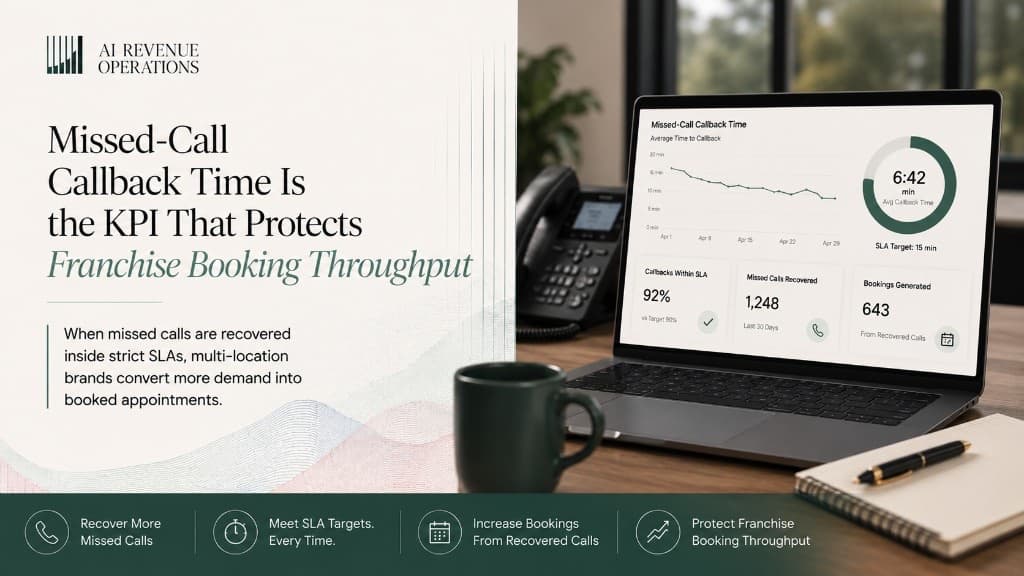
Missed-call callback time = median minutes from missed inbound call to first successful follow-up attempt
Then segment it by:
- location
- daypart
- weekday vs weekend
- campaign source when available
- first attempt channel (call, SMS, mixed)
Why median, not average? Averages hide outlier behavior. Medians reveal the operating reality most customers experience.
Pair this KPI with two support metrics:
- Callback within SLA (%)
- Missed-call-to-booking conversion rate (%)
Together, these expose both process discipline and business impact.
Current Market Signals Point in the Same Direction
Fresh signals in appointment-heavy categories keep pointing to the same operational pattern: teams that reduce missed-call latency capture more booking capacity.
Recent examples:
- Weave announced call-intelligence positioning around deferred care recovery and phone-conversion execution in practice workflows (Business Wire).
- Becker's Dental Review highlighted AI-driven missed-call reduction tied to chair utilization outcomes in clinic operations (Becker's Dental Review).
- HousingWire reinforced response-time advantage as a booking and win-rate driver in high-intent demand environments (HousingWire).
Different verticals, same lesson: callback latency is not support telemetry. It is a revenue variable.
Where Multi-Location Franchises Usually Break
In most systems, missed-call handling fails because ownership is split and standards are vague.
Common failure points:
- No network-wide callback SLA, only local preference.
- No event trigger linking missed calls to immediate workflows.
- Inconsistent queue discipline by shift and location.
- No priority routing for high-intent lead types.
- Weak scoreboard visibility for corporate and regional leaders.
This is why two locations with similar demand can produce very different booking outcomes.
The stronger location is not always "better at marketing." It is often better at callback execution.
Relationship to Existing Revenue KPIs
Missed-call callback time should not replace your existing metrics. It should connect them.
It operationalizes themes from:
- /blog/speed-to-lead-franchise-revenue-engine
- /blog/inquiry-to-booking-rate-franchise-revenue-ops
- /blog/no-show-recovery-franchise-revenue-system
If these KPIs are measured without callback discipline, teams get lagging insight but weak intervention.
A practical stack for weekly review:
- Missed-call callback time (median)
- Callback within SLA (%)
- Missed-call-to-booking conversion (%)
- Inquiry-to-booking rate (%)
- No-show rate (%)
- Recovery-to-rebook rate (%)
This gives one continuous view from first contact through booking reliability.
SLA Design That Actually Scales
A single rule like "call back fast" is not enough.
Define concrete SLA tiers:
- Business hours missed inbound calls: callback attempt within 5 minutes.
- Overflow windows: callback attempt within 10 minutes.
- After-hours missed calls: immediate acknowledgment + first callback at open.
- Priority services or high-LTV cohorts: accelerated callback queue with human routing.
Then define what counts as completion:
- successful call connection,
- confirmed two-way text response,
- or booked appointment event.
Without completion standards, location reporting drifts and comparisons become noise.
Corporate vs Location Ownership
Franchise systems improve fastest when governance is split clearly.
Corporate should own:
- KPI definitions and SLA policy
- workflow trigger logic
- reporting standards
- escalation rules for out-of-policy locations
Locations should own:
- queue execution by shift
- callback quality and booking conversation quality
- edge-case handling for local constraints
- staffing adjustments for call-volume patterns
This is the only split that preserves local execution flexibility while maintaining network consistency.
30-Day Implementation Blueprint
If you are not measuring this KPI today, start with a focused rollout.
Days 1-7: Baseline and instrument
- Capture all missed-call events by location.
- Record timestamp to first follow-up attempt.
- Build baseline median callback time and SLA completion rate.
Days 8-14: Standardize the operating rules
- Publish SLA tiers and completion definitions.
- Align regional leaders on exception handling.
- Train front desk and location managers on queue discipline.
Days 15-21: Automate trigger and routing
- Auto-create callback tasks from missed-call events.
- Route by priority and staffing availability.
- Add escalation for tasks breaching SLA windows.
Days 22-30: Enforce and coach
- Review scorecards weekly by region and location.
- Coach locations with repeat SLA misses.
- Tie improvements to missed-call-to-booking lift, not just activity volume.
At this stage, teams usually discover that callback consistency improves adjacent metrics with no additional media spend.
What Good Looks Like at Network Level
You do not need perfect call answer rates to improve booked revenue.
You need predictable missed-call recovery behavior:
- low variance in callback time across locations,
- high SLA attainment,
- and visible conversion lift from callback discipline.
When this pattern is in place, the network can scale demand without absorbing the same conversion leakage.
That is the difference between campaign growth and operating growth.
Final Takeaway
Missed-call callback time is one of the highest-impact operating KPIs for appointment-based franchise brands because it sits exactly where intent either converts or disappears.
Treat it as a governed revenue metric, not a local support metric.
When you do, inquiry-to-booking performance gets more stable, location variance narrows, and booking throughput becomes more predictable across the network.
If you want to run this KPI as part of one unified revenue operating layer, book a walkthrough of TractionDesk at /demo.