
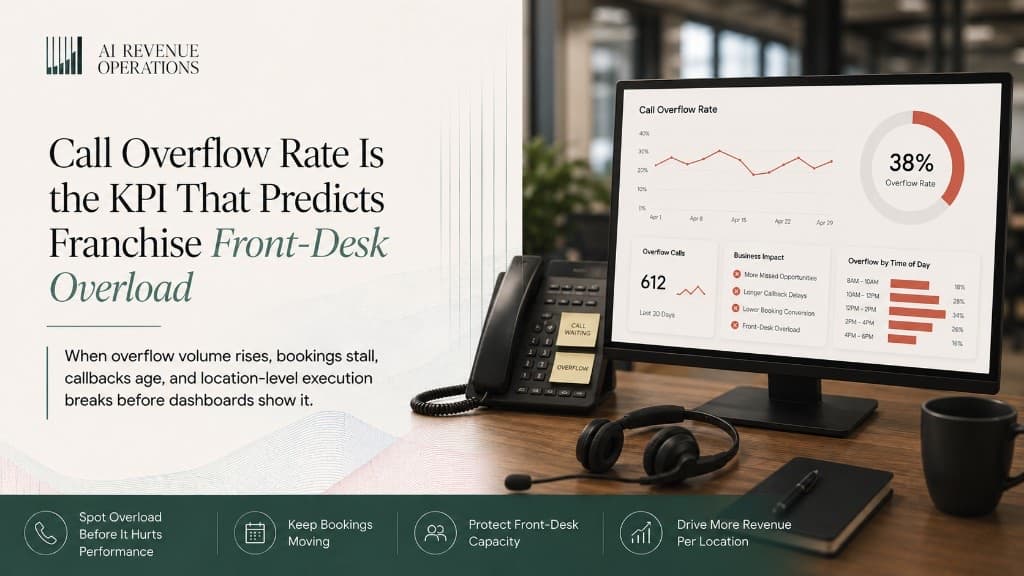
Most multi-location operators track call answer rate.
Fewer track what happens right after the system starts routing calls away from local teams.
That blind spot is expensive.
When call overflow climbs, three problems show up in sequence:
- Front-desk teams lose control of inbound demand.
- Follow-up queues get older and less likely to convert.
- Inquiry-to-booking performance falls with no obvious top-of-funnel cause.
By the time leadership notices slower bookings, the execution leak has already spread across shifts, locations, and campaigns.
That is why call overflow rate belongs in the same KPI tier as /blog/speed-to-lead-franchise-revenue-engine and /blog/inquiry-to-booking-rate-franchise-revenue-ops.
What Call Overflow Rate Actually Measures
Use one definition network-wide:
Call overflow rate = overflowed inbound calls / total inbound calls
Track it by:
- location
- daypart
- weekday vs weekend
- campaign source when available
- service line where routing differs
This is not a telecom metric for IT.
It is a revenue execution metric for operators.
A high overflow rate means your highest-intent channel is leaving the primary booking path too often. That pushes work into secondary queues where response times are slower and close rates are weaker.
Why Overflow Is a Leading Indicator, Not a Side Metric
Overflow typically moves before your headline conversion KPIs do.
That makes it useful for early intervention.
When overflow spikes, teams usually see downstream effects within days:
- longer callback latency
- weaker first-contact booking rate
- higher no-show risk because customers were booked later and with less context
In other words, overflow is a pressure gauge for the entire location-level operating layer.
If the gauge is red, conversion and retention instability usually follow.
Fresh Market Signals Point to the Same Pattern
Recent operating signals in appointment-heavy sectors reinforce the same theme: phone access quality drives capacity outcomes.
- Becker's reported dental operators using AI call handling to reduce missed-call leakage and protect chair utilization (Becker's Dental Review).
- Weave positioned call-intelligence around recovering deferred care demand where phone breakdowns were reducing booked procedures (Business Wire).
- Twilio and Microsoft updates continue to focus on real-time voice operations as a reliability layer, not just a chatbot feature (Twilio, Microsoft).
Different channels, same conclusion: once inbound access becomes inconsistent, booked revenue becomes inconsistent.
The KPI Stack That Makes Overflow Actionable
Do not track overflow alone. Pair it with adjacent execution metrics:
- Call overflow rate (%)
- Median callback time for overflowed calls
- Overflowed-call-to-booking conversion (%)
- Inquiry-to-booking rate (%)
- No-show recovery conversion (%)
Together, these show cause and effect.
If overflow rises but conversion holds, your backup workflows are working.
If overflow rises and conversion drops, your fallback execution is failing and needs immediate intervention.
Where Franchise Systems Break First
Most breakdowns are not technical. They are governance gaps.
Common failure points:
- no overflow threshold policy by location tier
- no ownership of overflow triage by shift
- no SLA for overflow callbacks
- no visibility for regional operators until week-end reporting
- no distinction between routine overflow and sustained overload
That is why two locations with similar lead volume can produce opposite booking outcomes.
The stronger location is rarely luckier. It has tighter overflow discipline.
Setting Practical Thresholds by Location Type
A single threshold for every location creates noise.
Use tiered targets:
- Mature, high-volume locations: lower tolerance for overflow spikes
- Newer locations: slightly wider tolerance while staffing patterns stabilize
- Peak windows: tighter escalation rules because intent is highest
A practical rule set looks like this:
- Green: overflow below baseline band
- Yellow: overflow above baseline for one daypart
- Red: overflow above threshold across consecutive dayparts or days
The key is not perfect precision.
The key is giving operators a shared language for when to intervene.
30-Day Operating Playbook
Days 1-7: Establish baseline
- Capture inbound and overflowed call events at location level.
- Calculate baseline overflow rate by daypart.
- Identify top outlier locations and top outlier shifts.
Days 8-14: Define governance
- Publish overflow thresholds and escalation triggers.
- Assign ownership by regional leader and location manager.
- Define callback SLA specifically for overflowed calls.
Days 15-21: Automate execution
- Trigger callback tasks immediately from overflow events.
- Route by priority cohort and availability.
- Flag tasks breaching SLA in real time.
Days 22-30: Enforce with scorecards
- Review overflow + booking conversion side by side.
- Coach repeat-outlier locations on queue discipline and staffing alignment.
- Track whether overflow improvements are translating into booked appointments.
This sequence is where teams turn overflow from a passive metric into an active operating control.
Corporate and Location Responsibilities
Corporate should own:
- KPI definitions and thresholds
- escalation policy
- reporting standards
- cross-location benchmarking
Locations should own:
- shift-level call handling
- callback quality
- local staffing adjustments
- compliance with overflow response SLAs
This split protects local flexibility while keeping execution standards consistent across the network.
Relationship to Existing TractionDesk Themes
Call overflow rate is the missing bridge between lead response speed and downstream booking reliability.
It connects directly to:
- /blog/multi-location-revenue-gap
- /blog/no-show-recovery-franchise-revenue-system
- /blog/missed-call-callback-time-franchise-booking-throughput
Without overflow discipline, teams keep diagnosing booking volatility as a marketing problem when the real issue is local execution pressure.
With overflow discipline, leadership sees capacity risk earlier and can correct before booked revenue is hit.
Final Takeaway
If your franchise system is missing booking targets while demand stays steady, check call overflow rate before you change campaigns.
Overflow is usually where front-desk load, callback delay, and conversion loss meet.
Treat it as a governed KPI, not an afterthought.
When overflow is measured and actively managed, location variance drops, response quality improves, and bookings become more predictable across the network.
If you want to operationalize overflow and callback execution in one unified revenue layer, book a TractionDesk walkthrough at /demo.