
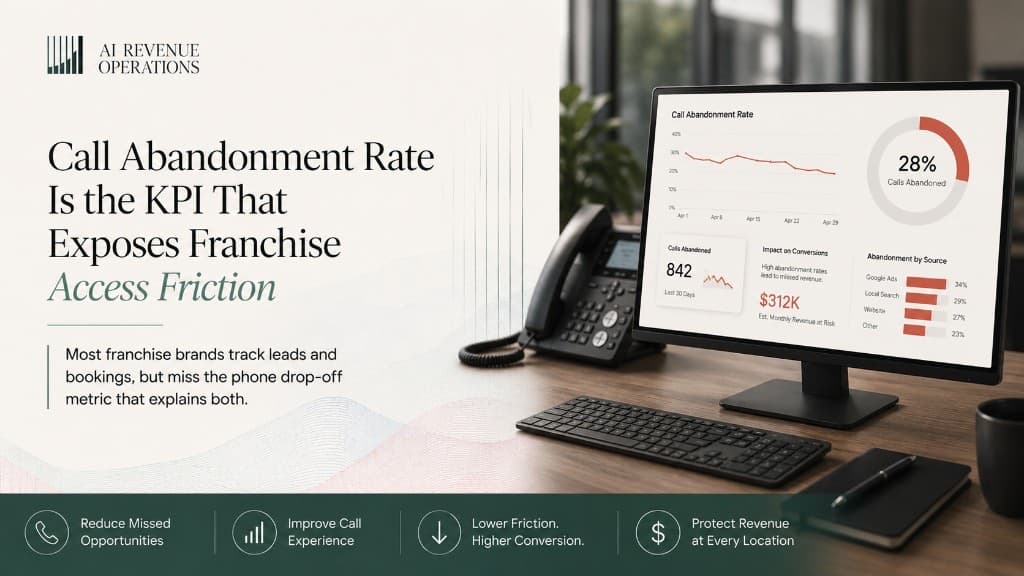
Most franchise teams can tell you how many leads came in this week. Most can tell you how many appointments were booked.
Far fewer can answer one of the most operationally important questions in the funnel:
How many inbound callers gave up before talking to someone?
That single number, measured as Call Abandonment Rate, is one of the cleanest indicators of location-level access friction. And for appointment-based franchise systems, access friction is revenue friction.
If a prospect hangs up, there is no booking conversation. If a returning customer hangs up, there is no retention conversation. If a high-intent caller hangs up twice, there is a good chance they book with a competitor.
This is why Call Abandonment Rate should be treated as a core revenue-operations KPI, not a call-center side metric.
What call abandonment rate actually measures
Call Abandonment Rate is the percentage of inbound calls that disconnect before an agent answers.
A practical formula:
Call Abandonment Rate = Abandoned Calls / Total Inbound Calls
At first glance it looks like a service metric. In practice, it is a throughput and conversion metric. It tells corporate teams whether locations can absorb demand when demand actually arrives.
You can generate demand all day through paid media, SEO, referral programs, and local partnerships. But if the phone layer fails at peak hours, your top-of-funnel investment leaks before locations even get a chance to sell.
Why this KPI matters in franchise systems
In single-location businesses, abandonment is painful. In franchise systems, abandonment compounds.
A small abandonment increase across dozens or hundreds of locations can mean thousands of missed conversations each month. That creates three systemic effects:
-
Lower lead-to-booking conversion High-intent calls are often the fastest path to booked appointments. If those calls drop, conversion falls even when lead volume stays flat.
-
Wasted acquisition spend Marketing teams can hit lead targets while locations still miss revenue targets because access infrastructure cannot handle inbound demand.
-
Invisible execution variance across locations Some units answer quickly and convert. Others lose callers in queue. Without abandonment visibility, corporate teams cannot see which locations need intervention.
This is the same pattern discussed in The Multi-Location Revenue Gap: demand is created centrally, but revenue is won or lost in local execution.
Abandonment does not happen in isolation
When abandonment goes up, it usually shows up alongside other stress signals.
- Call Overflow Rate rises when inbound volume exceeds front-desk handling capacity. See Call Overflow Rate Is the KPI That Predicts Franchise Front-Desk Overload.
- Missed-call callback latency expands when teams are stuck reacting to earlier queue failures. See Missed-Call Callback Time Is the KPI That Protects Franchise Booking Throughput.
- Inquiry-to-booking conversion softens as high-intent callers are lost before a sales interaction begins. See Inquiry-to-Booking Rate Is the KPI That Runs Franchise Revenue Operations.
In other words, abandonment is rarely the root cause by itself. It is usually the clearest symptom that your access system is under strain.
What “good” looks like (and what dangerous looks like)
Exact benchmarks vary by vertical and staffing model, but operators can use practical ranges:
- Under 5%: generally healthy access for most appointment-based systems
- 5% to 8%: caution zone; monitor by daypart and location
- Above 8%: likely revenue leakage requiring immediate operational review
- Above 10%: chronic access failure for many franchise contexts
The bigger mistake is chasing a universal magic number. The right question is trend and variance:
- Is abandonment climbing week over week?
- Which dayparts are failing?
- Which locations are outliers?
- Are high-spend campaigns being pushed into low-capacity windows?
That is where KPI monitoring becomes decision support.
The diagnostic stack corporate teams should run weekly
A useful weekly review packet for franchise leadership should include:
-
Abandonment rate by location Spot underperforming units quickly.
-
Abandonment by daypart Pinpoint capacity mismatch windows (open, lunch, post-work, weekend spikes).
-
Average speed to answer + queue depth Connect abandonment to handling constraints, not guesswork.
-
Missed-call callback time Measure recovery efficiency when callers are dropped.
-
Booking conversion by source Confirm whether paid and organic acquisition are being converted at the location layer.
With these together, operations can see whether they have a demand problem, a staffing problem, a routing problem, or a follow-up problem.
Common causes of high abandonment in franchise networks
Across appointment-driven brands, the same patterns repeat:
-
Static staffing against variable call demand Schedules are built around average volume, not spike intervals.
-
No queue strategy during peak windows Calls pile up with no escalation logic, no overflow logic, and no timely callback option.
-
Inconsistent location operating standards Some locations run tight phone workflows. Others treat inbound handling as ad hoc front-desk multitasking.
-
Disconnected tooling Call data, booking systems, and CRM records are fragmented, so no one sees full-funnel impact.
-
No corporate SLA for phone response Without a shared response standard, every location improvises.
Each of these is fixable. None are fixable without visibility.
How TractionDesk frames abandonment as revenue operations
TractionDesk’s core model is simple: convert demand into measurable revenue outcomes at the location layer.
In that model, Call Abandonment Rate is not a vanity support metric. It is an operating KPI tied to revenue execution.
For corporate franchise teams, that means:
- monitoring abandonment centrally,
- surfacing location-level outliers in real time,
- triggering recovery and follow-up workflows when calls drop,
- and standardizing access playbooks across the system.
The goal is not to produce prettier dashboards. The goal is to prevent high-intent conversations from disappearing before they can become booked appointments.
Operational playbook: what to do when abandonment spikes
When a location crosses your warning threshold, run a structured 7-day intervention:
-
Day 1: Confirm data integrity Validate call counts, queue logic, and time-window definitions.
-
Day 2: Segment by daypart Identify exact windows driving abandonment.
-
Day 3: Compare staffing coverage vs demand Check whether schedule design matches real inbound distribution.
-
Day 4: Tighten call routing and overflow handling Introduce escalation paths and callback pathways for peak periods.
-
Day 5: Enforce callback SLA Set and monitor strict callback-time targets for dropped calls.
-
Day 6: Link to booking outcomes Measure whether abandonment reduction improves booked appointments.
-
Day 7: Codify and replicate Turn successful changes into standard playbooks for similar locations.
This is how you move from reactive troubleshooting to repeatable operating discipline.
The strategic takeaway
Franchise growth does not usually fail because demand does not exist. It fails because demand is not captured consistently at the location level.
Call Abandonment Rate is one of the fastest ways to see that failure in motion.
If you track it rigorously, tie it to booking outcomes, and operationalize interventions across locations, you gain leverage where it matters most: execution.
If you ignore it, you will keep paying to generate leads that never become conversations.
That is not a marketing problem. That is a revenue-operations problem.
If your team wants a system-level view of where phone access friction is suppressing bookings, TractionDesk is built for exactly that layer.